
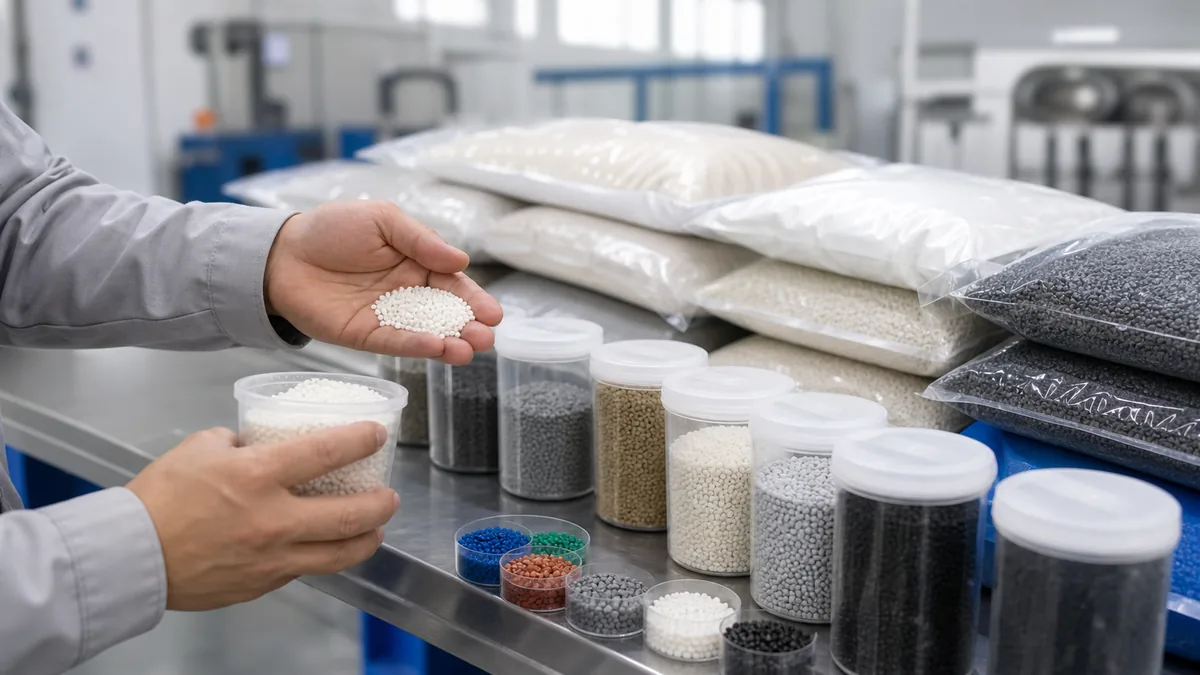
Choosing plastic material for injection molding is not only a price decision. The resin affects mold design, shrinkage, surface finish, tolerance, cycle time, assembly fit and long-term performance.
Many problems start when the material is selected too late. A part designed for ABS may not behave the same way in PP or PA. A housing that looks fine in PC/ABS may show sink marks if the wall thickness and ribs are not reviewed. A flexible seal made with the wrong hardness may pass the first sample review but fail in assembly.
This guide explains how buyers and engineers can compare common materials such as ABS, PP, PC, PA, POM, TPU, TPE, PMMA and PC/ABS before opening an injection mold.
Start with the part function, not the resin name
A good material choice starts with the actual job of the plastic part. Is it a cosmetic cover, a clip, a gear, a sealing part, a transparent window, a medical housing or an internal bracket? Each application has different priorities.
- Will the part be visible to the end user?
- Does it need impact strength, stiffness or wear resistance?
- Will it contact heat, chemicals, oil, water or UV exposure?
- Does it need to snap together with another part?
- Are tight dimensions or flatness important?
- Does the part need painting, printing, plating, ultrasonic welding or assembly?
Once these questions are clear, the material discussion becomes practical. The goal is not to choose the most expensive resin. The goal is to choose a resin that can meet the requirement and still run stably in production.
Common injection molding materials and where they fit
| Material | Typical use | What to check before tooling |
|---|---|---|
| ABS | Housings, covers, appliance parts, consumer and industrial plastic parts. | Cosmetic surface, impact requirement, painting or plating, sink mark risk around bosses and ribs. |
| PP | Lightweight covers, containers, living hinges, clips and chemical-resistant parts. | Shrinkage, warpage, stiffness, hinge design, appearance expectation. |
| PC | Strong housings, transparent covers, electrical and safety-related parts. | Wall thickness, stress cracking risk, drying, mold temperature and surface requirement. |
| PC/ABS | Electronic housings, automotive interior parts, durable covers. | Impact strength, heat resistance, texture, flame-retardant grade if required. |
| PA / Nylon | Functional parts, brackets, gears, clips and wear-resistant components. | Moisture absorption, dimensional change, glass fiber content, wear and strength requirement. |
| POM | Gears, sliding parts, bushings, small mechanical components. | Low friction, tight tolerance, gate position, shrinkage and possible deformation. |
| TPU / TPE | Flexible seals, soft-touch parts, pads, grips and protective components. | Hardness, bonding, deformation, surface feel, flash control and ejection method. |
| PMMA | Light guides, clear covers, lenses and cosmetic transparent parts. | Polishing, scratch resistance, flow marks, gate location and packaging protection. |
ABS: a practical choice for housings and covers
ABS is often used for plastic housings, covers, panels and general industrial parts because it offers a good balance of toughness, moldability and surface appearance. It is easier to paint or plate than many other plastics, so it is common in products where appearance matters.
For ABS parts, the common tooling questions are wall thickness, ribs, bosses, texture and gate location. Thick bosses behind a visible surface can create sink marks. Long thin ribs can create filling or ejection problems if the draft is too small.
Review more details on our ABS injection molding page.
PP: light, flexible and cost-effective when designed correctly
PP is useful when the part needs light weight, chemical resistance or a living hinge. It can be a good option for covers, caps, containers and certain functional parts. However, PP has higher shrinkage than ABS and can warp if the part design is not balanced.
When we review PP parts, we pay close attention to wall thickness, rib layout, gate position and flatness. For parts that must assemble tightly with another component, dimensional control should be discussed before tooling.
Review more details on our PP injection molding page.
PC and PC/ABS: stronger housings and heat-resistant applications
PC is chosen when higher impact strength, clarity or heat resistance is needed. PC/ABS is commonly used when a buyer needs a stronger housing with better processability than pure PC. It is widely used in electronics, automotive interior components and durable product covers.
For these materials, mold temperature, drying, gate position, wall thickness and stress control matter. If the part will use screws, clips or ultrasonic welding, these areas should be reviewed early because stress concentration can cause cracking later.
PA and POM: functional parts need dimensional thinking
PA and POM are common for functional parts such as gears, brackets, sliding parts and mechanical components. These parts often need strength, stiffness, wear resistance or low friction.
The challenge is that functional parts usually care more about dimensions than appearance. PA can absorb moisture and change dimension. Glass-filled PA improves stiffness but can increase tool wear and affect surface finish. POM has good sliding performance but still needs careful gate and shrinkage control.
For these materials, it is better to provide the assembly drawing, load condition and critical dimensions, not only the part model.
TPU and TPE: flexible materials are not all the same
TPU and TPE are used for soft-touch parts, seals, pads, covers and protective components. The first question is hardness. A small difference in hardness can change assembly feel, sealing pressure and deformation.
Flexible materials can also flash more easily than rigid plastics if the mold shut-off is not controlled. The ejection method, gate position and part thickness should be reviewed before mold manufacturing.
Material choice changes mold design
The same part geometry may need different mold decisions when the material changes. This is why material selection should be confirmed before mold steel cutting whenever possible.
- Shrinkage: PP, PA and POM generally need more careful shrinkage review than ABS.
- Flow behavior: Thin walls, long flow paths and gate location depend on the resin.
- Tool wear: Glass-filled materials can wear gates, cavities and inserts faster.
- Surface finish: Transparent and high-gloss parts need better polishing and cleaner molding conditions.
- Cooling: Thick walls and heat-sensitive parts may need stronger cooling design.
- Ejection: Soft materials and deep ribs may need different ejection support.
How material affects cost
Material cost is only one part of the total price. A resin that is cheap per kilogram may still create higher cost if it causes warpage, long cycle time, difficult inspection or high scrap. A more expensive resin may be the better choice if it reduces risk in assembly or field use.
| Cost factor | Why material matters |
|---|---|
| Resin price | Engineering plastics usually cost more than common commodity plastics. |
| Cycle time | Thicker parts or materials needing higher mold temperature may run slower. |
| Scrap rate | Cosmetic or transparent parts may need more careful control and inspection. |
| Mold wear | Glass-filled or abrasive materials may require better steel or more maintenance. |
| Inspection | Functional materials often need tighter dimensional checks. |
For a broader cost discussion, see our guide: How Much Does Injection Molding Cost?
Information to send for a material review
If you want a realistic recommendation, the following information is useful:
- 3D file and 2D drawing if available.
- Application industry and where the part is used.
- Expected load, temperature, chemical contact or outdoor exposure.
- Surface finish, color and texture requirement.
- Assembly method, screws, clips, inserts, welding or sealing requirement.
- Expected production quantity and annual demand.
- Whether the part needs a specific resin grade, UL rating or customer-approved material.
How Yuming Molding supports material selection
Yuming Molding reviews material choice together with DFM, mold design and production risk. For overseas projects, we normally confirm the drawing, part function, material requirement, mold steel, cavity number, sample review plan and inspection points before production starts.
We can process common injection molding materials including ABS, PP, PC, PA, POM, TPU, TPE, PMMA, PBT and PC/ABS. For special resin grades, buyers can provide the material data sheet or approved supplier information.
Related pages: Plastic materials, plastic injection molding services, injection mold manufacturing and quality control.
FAQ: Plastic materials for injection molding
Which plastic material is best for injection molding?
There is no single best material. ABS, PP, PC, PA, POM, TPU and TPE are all good choices when they match the part function. The right material depends on strength, appearance, flexibility, heat, chemical exposure, tolerance and cost.
Can I change material after the mold is built?
Sometimes yes, but it is not always simple. A material change can affect shrinkage, dimensions, filling, warpage and surface finish. It is better to discuss material options before mold manufacturing.
What if I only know the part function but not the resin?
You can send the part drawing, application and working conditions. We can discuss common resin options and possible risks during quotation and DFM review.
Do glass-filled materials affect mold cost?
Yes, they can. Glass-filled materials may increase tool wear and may require better steel, stronger gates or more maintenance planning.
Need help choosing material for a plastic part?
Send your drawing, target quantity and application details. We can review the material choice together with DFM and mold requirements.
Leave a Reply