
The honest answer is that injection molding cost is not one number. A quote usually has two different parts: the mold cost and the molded part price. If these two numbers are not separated clearly, it is easy to compare suppliers in the wrong way.
For a simple plastic part, the mold may cost only a few thousand dollars. For a larger part, tight-tolerance part, multi-cavity mold, hardened steel production mold or project with slides and lifters, tooling can move into the tens of thousands. The part price then depends on resin, shot weight, cycle time, machine size, labor, inspection and packing.
This guide explains how we look at injection molding cost at Yuming Molding before we quote a custom plastic part project.
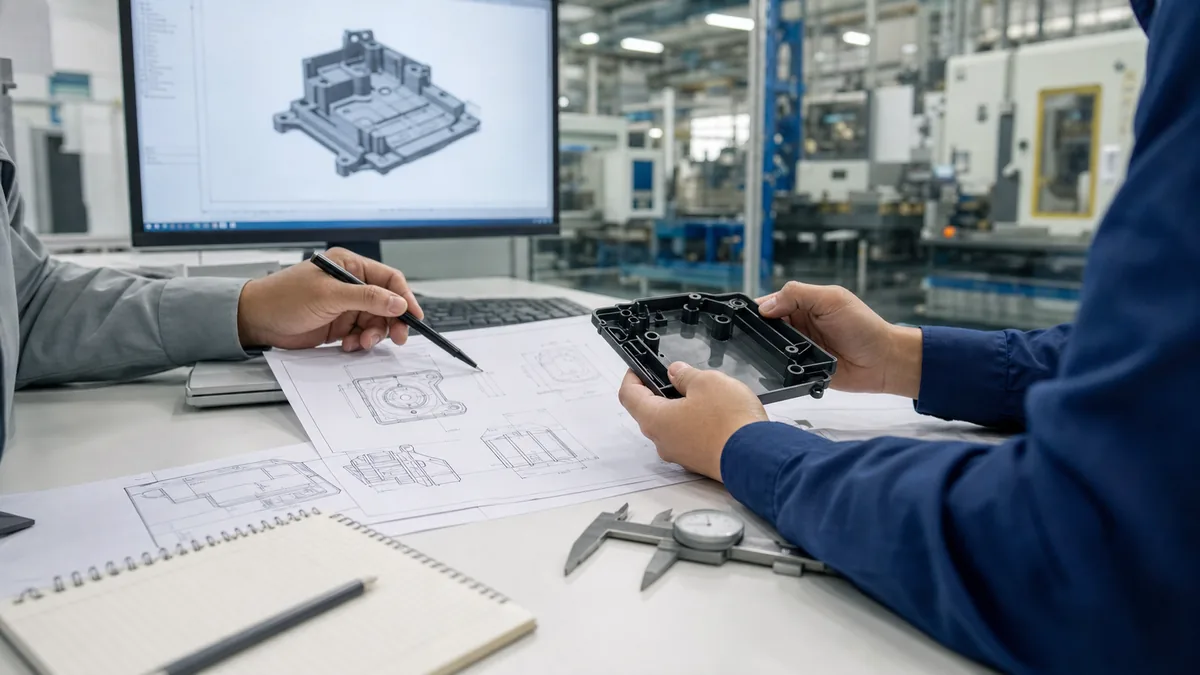
Injection molding cost has two main parts
When a buyer asks, “How much does injection molding cost?”, the first thing to clarify is whether they mean mold tooling cost or production part cost. These are related, but they are not the same.
| Cost Item | What it includes | When you pay it |
|---|---|---|
| Mold tooling cost | Mold design, mold steel, CNC machining, EDM, fitting, polishing, texture, trial and corrections. | Usually before or during mold manufacturing. |
| Molded part price | Plastic resin, machine time, labor, inspection, scrap allowance, packaging and production management. | Each production order. |
| Secondary operations | Painting, printing, inserts, assembly, ultrasonic welding, special packing or extra inspection. | When the part requires it. |
A low mold price is not always the lowest total project cost. If the mold is not designed for stable production, the buyer may pay later through delays, repeated mold changes, high scrap, poor surface quality or assembly problems.
Typical mold cost ranges
Every mold is different, but these ranges are useful for early planning. They are not fixed prices. A real quotation still needs the drawing, material, tolerance, surface requirement and production quantity.
| Project Type | Typical Tooling Level | General Cost Range |
|---|---|---|
| Prototype or simple test mold | Simple structure, low shot requirement, used for validation. | Often from a few thousand USD. |
| Small single-cavity production mold | For one custom part with standard material and moderate requirements. | Commonly in the low thousands to mid-five-figure range. |
| Multi-cavity production mold | Higher output, better cycle efficiency, more machining and balancing work. | Often higher because mold size and precision increase. |
| Complex mold with slides, lifters or tight tolerance | Side actions, shutoffs, complex parting line, detailed polishing or engineering changes. | Can move into the tens of thousands depending on complexity. |
What affects injection mold cost?
1. Part size and mold size
A larger plastic part usually needs a larger mold base, more steel, more machining time and a larger injection molding machine. Even if the part shape is simple, size alone can increase tooling and production cost.
2. Part complexity
Undercuts, side holes, clips, screw bosses, deep ribs, thin walls and cosmetic surfaces all affect mold design. If the part requires sliders, lifters, inserts or special ejection, the mold becomes more expensive because there are more moving parts and more fitting work.
3. Mold steel and mold life
A short-run mold does not need the same steel as a long-life production mold. For repeat production, buyers may choose better mold steel, heat treatment or higher wear resistance. This increases the initial mold cost but can reduce repair problems later.
4. Cavity count
A single-cavity mold is usually cheaper to build, but the part price may be higher because each cycle produces only one part. A multi-cavity mold costs more at the beginning, but it can reduce the unit price when annual volume is high enough.
5. Surface finish and cosmetic requirements
Glossy surfaces, visible covers, texture matching, clear parts and tight appearance standards require more polishing, texture control and inspection. A part hidden inside a machine is usually easier than a customer-facing housing.
6. Tolerance and assembly fit
Tight tolerances require better mold accuracy, stable shrinkage control and more inspection. If a plastic part must fit with metal parts, electronics, seals or other molded components, the supplier needs to review critical dimensions early.
What affects the molded part price?
After the mold is built, the unit price is driven by production details. The most common factors are material, part weight, cycle time, machine tonnage, scrap rate, labor, inspection and packaging.
| Factor | Why it matters |
|---|---|
| Plastic material | ABS, PP, PC, PA, POM, TPU and PC/ABS all have different resin costs and processing behavior. |
| Shot weight | More plastic per part means higher material cost. |
| Cycle time | Long cooling time or slow ejection increases machine time per part. |
| Machine size | Larger machines cost more to run than small machines. |
| Inspection level | Critical dimensions, cosmetic inspection and packing checks add time but reduce delivery risk. |
| Packaging | Export cartons, separated packing, labels and protective materials affect total delivered cost. |
Example: why two similar parts can have different prices
Imagine two ABS plastic covers. Both are about the same size and use the same material. One cover is a simple internal part. The other is a visible housing with clips, screw bosses, texture and a tight fit to another component.
The material cost may be close, but the tooling and production cost can be very different. The visible housing may need better polishing, more DFM discussion, careful gate placement, more trial adjustment and more inspection before packing. That is why a real injection molding quote must look at the drawing, not only the outside size.
A cheaper mold may be suitable when:
- The part is simple and used for validation.
- Production volume is low.
- The part has no difficult surface or assembly requirement.
- The buyer accepts shorter mold life.
A stronger production mold is better when:
- The part will be ordered repeatedly.
- Assembly fit and appearance matter.
- Material is abrasive or difficult to process.
- The project needs stable production over time.
How to reduce injection molding cost without creating problems
Cost reduction should start before mold manufacturing, not after the mold is already built. The best time to save money is during DFM review.
- Simplify unnecessary undercuts. Reducing slides or lifters can lower mold cost and maintenance risk.
- Keep wall thickness practical. Overly thick walls increase cooling time and can cause sink marks.
- Choose material based on function. Do not use expensive engineering resin if PP or ABS is enough for the application.
- Confirm cosmetic areas early. If only one side is visible, the mold finish can be planned more efficiently.
- Match cavity count to real volume. Multi-cavity molds are not always the best choice for low-volume projects.
- Send complete files. Clear 3D files, 2D drawings and quantity estimates reduce back-and-forth and prevent wrong assumptions.
What files are needed for an accurate quote?
To quote injection molding properly, we normally ask for:
- 3D file: STEP, STP, X_T, SLDPRT or similar format.
- 2D drawing or PDF if tolerances, threads or critical dimensions matter.
- Plastic material or functional requirement.
- Surface finish, color and texture requirement.
- Expected production quantity or annual volume.
- Application industry and assembly requirement.
- Packaging or export shipping requirement if known.
If you do not know the best resin yet, send the application and working environment. We can discuss common options such as ABS injection molding, PP injection molding, PC, PA, POM, TPU or PC/ABS.
Common mistakes when comparing injection molding quotes
- Only comparing the mold price. A low mold cost can become expensive if the mold is hard to run.
- Ignoring mold life. A mold for 10,000 shots and a mold for 500,000 shots should not be compared as the same product.
- Not checking what is included. Mold trial, sample shipping, polishing, texture and engineering changes may be handled differently by each supplier.
- Not defining inspection requirements. Critical dimensions and cosmetic surfaces should be clear before production.
- Using the wrong material early. Changing resin after mold design can affect shrinkage and part dimensions.
How Yuming Molding prepares an injection molding quote
At Yuming Molding, we review the project as a mold and production problem, not only a price request. Before quoting, we look at moldability, material, part structure, production quantity, surface requirements, critical dimensions and packaging.
For projects that need more review, we may discuss DFM points such as wall thickness, draft angle, rib design, boss strength, parting line, gate location and possible sink marks or weld lines. This helps the buyer understand the real cost drivers before mold steel cutting.
You can also review our plastic injection molding services, injection mold manufacturing, quality control process and case studies to see how we describe project information.
FAQ: Injection molding cost
Is injection molding expensive?
The mold cost can be expensive at the beginning, but the unit price becomes more efficient when production volume increases. That is why injection molding is usually better for repeat production than for only a few parts.
Can I get a quote without a 3D file?
Yes, but it will be less accurate. Product photos, rough dimensions and material ideas can help with early discussion, but a reliable quote normally needs a 3D model and drawing.
Does a multi-cavity mold always save money?
No. Multi-cavity molds reduce unit cost only when volume is high enough. For prototype and low-volume projects, a simpler mold may be more practical.
What is the biggest cost driver?
For the mold, complexity and mold structure are usually major drivers. For the part price, material, cycle time, machine size and inspection level are important.
Need a realistic injection molding cost review?
Send your 3D file, drawing, material, quantity and application details. We can review moldability, tooling approach, production cost drivers and quality risks before quotation.
Leave a Reply